BioVeris is a drop-in biodegradable composite resin for real plastic parts. Patented chemistry turns natural fillers into structural reinforcement — so the same material that delivers plastic-grade performance in use also fully biodegrades at end of life, on a predictable timeline, in real-world soil and home-compost conditions.
No one has solved all four at once. The problems are interlocking — fixing one usually breaks another. BioVeris addresses all four simultaneously.
BioVeris biodegrades in soil, home compost, and industrial compost — the polymer carbon mineralizes and returns to the natural carbon cycle rather than persisting as microplastic fragments. Independent screening under the ISO 14855 protocol supports the pathway. Formal certification testing is underway across all three.†
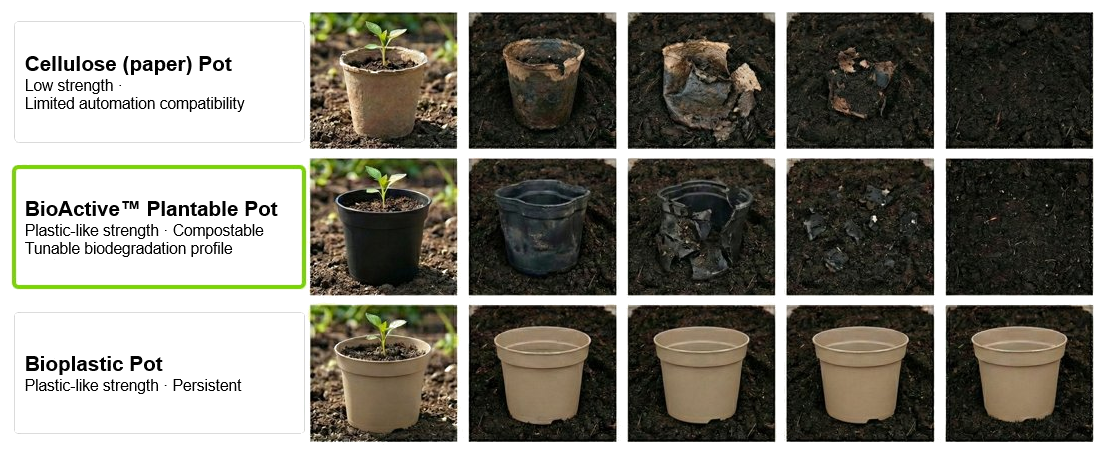
A common failure mode in "biodegradable" plastics is fragmentation: a part appears to disappear, but in fact breaks down into microplastic particles. Oxo-degradable plastics are the worst case — the fragments are genuinely persistent and accumulate in soil and water. Other biodegradable polyesters eventually break down further on the order of years, but they still pass through a measurable microplastic phase along the way. The relevant distinction is disintegration vs. mineralization. Disintegration means a part visibly falls apart. Mineralization means the polymer carbon is fully metabolized by microorganisms and returned to the natural carbon cycle as CO₂ and biomass. Many products marketed as biodegradable only ever disintegrate. They never mineralize.
ISO 14855 is the recognized international standard for distinguishing real biodegradation from fragmentation. It measures actual carbon mineralization — the conversion of polymer carbon into CO₂ by soil microorganisms — under controlled conditions. It is the test that separates marketing claims from material reality.
BioVeris has undergone independent screening tests at a third-party laboratory under the ISO 14855 protocol. The screening data is consistent with full carbon mineralization and indicates no microplastic residue at the conclusion of the test cycle. Formal certification testing is now underway across the relevant pathways — home compostable, industrial compostable, and soil biodegradation. Certification marks have not yet been issued.†
The biodegradation rate is not fixed; it is a formulation lever. Different blends produce different degradation curves, allowing the material to be matched to the application — a propagation pot intended to plant directly into soil has different lifetime requirements than a hard-walled retail container. The mechanism is repeatable, formulation-controlled, and built into the chemistry rather than added as a coating or post-treatment.
BioVeris is engineered with mechanical and physical properties between PP and PS — the workhorse plastics behind most consumer and industrial parts. Different formulations land at different points in that range, all of them in the commodity-plastic class, and our formulated products run on standard industrial equipment at production-line speeds. That combination is the real proof point.
The real test of a biodegradable material isn't a flexural number on a datasheet — it's whether it can run on the same equipment your existing plastic runs on, at the same rate, with the same scrap rate. Most biodegradable resins quietly fail that test long before they reach commercial volume.
BioVeris has been validated on a high-volume, fully automated commercial thermoforming line — not pilot equipment, not test bars. Cycle times match conventional plastics. No tooling changes. No process modifications. The material flows through standard equipment the same way a PP or PS compound would.
And it's a material system, not a single grade. Our formulated products run through thermoforming, injection molding, blown and cast film, sheet extrusion, and blow molding — the grade is tuned to the process. A manufacturer adopting BioVeris is betting on a material system that fits the line they already operate, not on one universal pellet.
High natural-filler loading drives material cost toward commodity plastics — without subsidies, premium channels, or niche markets.
The economics of biodegradable polymers are governed by one variable: how much polymer is in the part. Most certified-biodegradable alternatives are mostly polymer — high-cost specialty resins (PHA-class polyesters, PLA, compostable aliphatic-aromatic copolyesters) that price at multiples of commodity polyolefins. Even with bio-based feedstocks, the underlying chemistry is expensive, and the businesses built on it have so far relied on regulatory tailwinds — single-use bans, EPR mandates, production incentives — rather than self-sustaining unit economics.
BioVeris turns this equation around. The KREX chemistry enables natural-filler loading at levels well above industry norms — agricultural residues, starches, cellulose, and similar materials that cost a fraction of any synthetic polymer. Industry-standard composites typically cap below 30% natural-filler loading before mechanical performance collapses; competitors who push past that ceiling do so by adding expensive, non-biodegradable compatibilizers — which solves the strength problem and breaks the biodegradation one. BioVeris's covalent compatibilization is the chemistry that lets us run up to 60% filler, formulation-dependent, with the biodegradation pathway intact.
This is structural cost reduction, not a process trick. It compounds as filler loading increases, and it scales with volume rather than against it. The result is a cost trajectory that bends toward commodity plastics, not away from them.
Regulatory pressure pushes the gap closed from the other side. As Extended Producer Responsibility (EPR) regulation raises the cost floor on conventional plastics by attaching mass-based end-of-life fees, commodity plastics get more expensive while BioVeris gets less. Cost parity stops being a stretch goal and becomes the baseline.
In conventional composites, fillers are inert dispersions. In BioVeris, they are covalently bonded into the polymer network — load-bearing and bioavailable at the same time.
Public awareness of microplastics, PFAS, and the "forever chemicals" problem is no longer fringe — it is mainstream consumer pressure, retailer pressure, and regulatory action. Extended Producer Responsibility (EPR) laws are translating that pressure into balance-sheet economics by shifting end-of-life costs upstream onto producers. For three decades, biodegradable materials competed against conventional plastics on price and lost. That equation has changed.
Anonymized resin classes scored on the dimensions that decide whether a biodegradable material reaches commercial scale: real biodegradation, mechanical performance, processability on standard equipment, cost competitiveness, and EPR relief eligibility. Not a Kaimarra claim — an observation from publicly available resin datasheets.
| Resin class | Real biodegradation (soil + home compost) |
Mechanical performance (PP / PS class) |
Processability on standard equipment |
Cost competitiveness at scale |
EPR relief eligibility |
|---|---|---|---|---|---|
| BioVeris™Covalent-compatibilized biodegradable composite | ✓ | ✓ | ✓ | ✓ | ✓ |
| Polylactic-acid polyestersHDT 58°C · industrial compost only | − | brittle | partial | partial | − |
| PHA-class polyestersSoil-biodegradable but low melt strength | ✓ | limited | − | − | ✓ |
| Compostable aliphatic-aromatic copolyestersIndustrial-compost-only certification | − | soft | ✓ | − | partial |
| Filler-loaded starch blendsPast ~30% loading requires non-biodegradable compatibilizers | partial | limited | partial | partial | partial |
| Cellulose / molded-fiber potsBiodegradable but mechanically and logistically fragile | ✓ | − | − | − | ✓ |
| Conventional petroplastics (PP / PS / PE)Cost floor · not biodegradable — reference only | − | ✓ | ✓ | ✓ | − |
Lab data and real-world performance often diverge. A material that passes mechanical specs on standardized test pieces may behave very differently when it has to survive automated material handling, fertigation chemistry, mechanical jostling during shipping, and the weight of a growing root ball.
† Biodegradation claims on this page are supported by extensive internal development data and independent screening at a third-party laboratory under the ISO 14855 protocol. Formal certification testing across the relevant pathways — home-compostable, industrial-compostable, and soil-biodegradation — is currently in flight; certification marks have not yet been issued. Until those programs complete, biodegradation language on this page should be read as screening- and data-supported, not certified. Forward-looking statements about certification timing, formulation refinement, and projected performance are subject to test outcomes and third-party scheduling.
BioVeris is in commercial production today. If you're a manufacturer working on EPR exposure, looking to replace conventional plastics on existing lines, or evaluating biodegradable materials for high-spec applications — we'd like to hear from you.